10:00 AM to 6:30 PM - Mon to Sat
Understanding the Basics of Compressors
30
JUL
Understanding the Basics of Compressors
Compressors are among the most important components used in refrigeration, air-conditioning, and HVAC systems. They are often described as the “heart” of a cooling system because they keep the refrigerant circulating and create the pressure difference required for effective heat transfer. Without a properly functioning compressor, an air-conditioning or refrigeration system cannot maintain the desired temperature.
Compressors are among the most important components used in refrigeration, air-conditioning, and HVAC systems. They are often described as the “heart” of a cooling system because they keep the refrigerant circulating and create the pressure difference required for effective heat transfer. Without a properly functioning compressor, an air-conditioning or refrigeration system cannot maintain the desired temperature.
Whether you are an HVAC professional, technician, business owner, or simply interested in cooling technology, understanding the basic operation of compressors can help you make better decisions about equipment selection, performance, maintenance, and replacement.
What Is a Compressor?
A compressor is a mechanical device that increases the pressure of a gas by reducing its volume. In an HVAC or refrigeration system, the compressor receives low-pressure refrigerant vapour from the evaporator and compresses it into a high-pressure, high-temperature vapour.
This compressed refrigerant then travels to the condenser, where it releases heat and changes into a liquid. The refrigerant continues through the expansion device and evaporator before returning to the compressor. This continuous process is known as the refrigeration cycle.
The compressor does not directly produce cold air. Instead, it circulates the refrigerant and provides the energy needed to move heat from one location to another.
How Does a Compressor Work?
The basic operation of a refrigeration compressor can be understood in four stages:
1. Suction
Low-pressure and low-temperature refrigerant vapour enters the compressor through the suction line. The refrigerant arriving at this stage has already absorbed heat from the conditioned space inside the evaporator.
2. Compression
The compressor reduces the volume of the refrigerant vapour. As the vapour is compressed, both its pressure and temperature increase considerably.
3. Discharge
The high-pressure, high-temperature refrigerant vapour leaves the compressor through the discharge line and flows towards the condenser.
4. Continuous Circulation
The process continues as long as the system is operating. By maintaining a pressure difference between the evaporator and condenser, the compressor enables the refrigerant to absorb and release heat efficiently.
Common Types of Compressors
Different systems require different compressor designs. The selection depends on cooling capacity, operating conditions, energy-efficiency requirements, application, and available space.
Reciprocating Compressors
Reciprocating compressors use pistons moving inside cylinders to compress refrigerant. Their operating principle is similar to that of an automobile engine.
These compressors are widely used in domestic refrigerators, cold rooms, commercial refrigeration systems, and smaller air-conditioning applications. They offer reliable performance and are available in several capacities. However, they may produce more vibration and contain more moving components than some other compressor types.
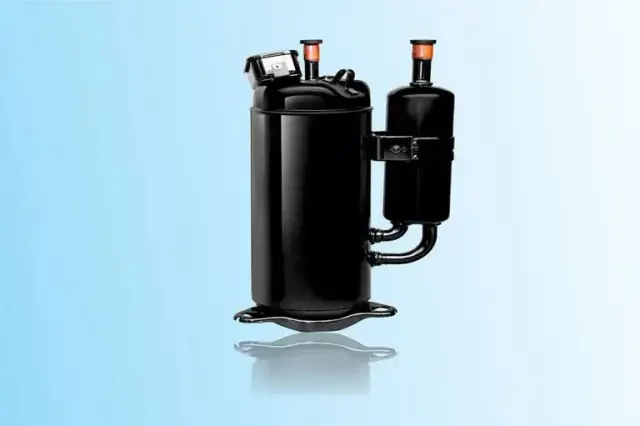
Rotary Compressors
Rotary compressors use rotating components to compress the refrigerant. They are compact, operate smoothly, and generally produce less vibration than traditional reciprocating compressors.
They are commonly found in room air conditioners, split AC units, heat pumps, and compact refrigeration systems. Rotary compressors are particularly suitable for applications where limited space, low noise, and steady operation are important.
Scroll Compressors
A scroll compressor contains two spiral-shaped scrolls. One remains fixed while the other moves in an orbital motion. This movement traps and gradually compresses the refrigerant towards the centre.
Scroll compressors are known for quiet operation, good energy efficiency, and fewer moving parts. They are frequently used in residential and commercial air-conditioning systems, heat pumps, and packaged HVAC equipment.
Screw Compressors
Screw compressors use two interlocking helical rotors to compress refrigerant continuously. They are designed to handle larger cooling loads and offer stable operation under demanding conditions.
These compressors are commonly used in industrial refrigeration plants, large commercial buildings, process cooling systems, and central chilled-water installations. Their capacity-control capabilities make them suitable for systems with changing cooling requirements.
Centrifugal Compressors
Centrifugal compressors increase refrigerant pressure by using a rapidly rotating impeller. Unlike positive-displacement compressors, they rely on centrifugal force and the conversion of velocity into pressure.
They are normally used in high-capacity applications such as large commercial complexes, manufacturing facilities, hospitals, airports, and district cooling plants. Centrifugal compressors can deliver highly efficient performance when operating near their designed capacity.
Main Compressor Components
Although compressor construction varies by type, several components are commonly involved in its operation:
- The motor provides the mechanical power required for compression.
- The compression mechanism may include pistons, rotors, scrolls, screws, or an impeller.
- Suction and discharge connections control the refrigerant flow entering and leaving the compressor.
- Bearings support rotating parts and allow smooth movement.
- Lubricating oil reduces friction, controls wear, and assists with heat management.
- The compressor shell or housing protects internal components and helps contain refrigerant and oil.
- Electrical terminals and protective devices support safe operation and help prevent damage caused by abnormal conditions.
Understanding these components helps technicians identify faults and perform accurate maintenance.
Hermetic, Semi-Hermetic, and Open Compressors
Compressors can also be classified according to their construction.
In a hermetic compressor, the motor and compression mechanism are sealed inside a welded housing. The sealed design reduces refrigerant leakage and makes the unit compact. However, internal repairs are usually impractical.
A semi-hermetic compressor also contains the motor and compression mechanism inside a common housing, but the housing can be opened for servicing. These compressors are commonly used in commercial and industrial refrigeration.
An open compressor has an external motor connected to the compressor through a shaft or coupling. It can be repaired more easily, but the shaft seal requires proper inspection to prevent refrigerant leakage.
Factors to Consider When Selecting a Compressor
Choosing the correct compressor is essential for achieving dependable system performance. Important factors include:
- Required cooling capacity
- Type of refrigerant
- Evaporating and condensing temperatures
- Power supply and electrical specifications
- Expected operating hours
- Energy-efficiency requirements
- Noise and vibration limits
- Available installation space
- Ambient operating conditions
- Serviceability and spare-parts availability
An oversized compressor may cycle frequently and operate inefficiently, while an undersized compressor may run continuously without achieving the required temperature. Compressor selection should therefore be based on accurate load calculations and manufacturer recommendations.
Common Signs of Compressor Problems
A compressor usually shows warning signs before a complete failure. These may include unusual noise or vibration, reduced cooling, frequent tripping, excessive power consumption, high discharge temperature, hard starting, oil leakage, refrigerant leakage, or continuous operation.
Some symptoms that appear to indicate compressor failure may actually result from electrical problems, incorrect refrigerant charge, restricted airflow, blocked filters, dirty condenser coils, or defective control components. A qualified technician should inspect the complete system before recommending compressor replacement.
Essential Compressor Maintenance Tips
Regular maintenance can improve compressor reliability and extend the operating life of the entire system. Important practices include checking refrigerant pressure, inspecting electrical connections, monitoring voltage and current, maintaining the correct oil level, cleaning condenser and evaporator coils, and ensuring unrestricted airflow.
Technicians should also inspect filters, driers, suction lines, valves, mounting points, and protective controls. Refrigerant and oil contamination must be prevented because moisture, dirt, and acids can damage internal components.
When replacing a failed compressor, the cause of the original failure must be identified and corrected. Installing a new compressor without resolving contamination, poor lubrication, incorrect refrigerant charging, overheating, or electrical faults may lead to repeated failure.
Final Thoughts
The compressor plays a central role in every refrigeration and air-conditioning system. It maintains refrigerant circulation, creates the required pressure difference, and enables the system to transfer heat efficiently.
Understanding compressor types, operating principles, selection factors, and common maintenance requirements makes it easier to improve performance and avoid unexpected breakdowns. The right compressor, supported by proper installation and regular servicing, can deliver efficient, reliable, and long-lasting operation across residential, commercial, and industrial cooling applications.
Tags:
- Compressors
- HVAC Systems
- Refrigeration
- Compressor Maintenance
- Cooling Technology
Related Blogs

27
JUL
Latest HVAC&R Trends in 2026: Energy-Efficient Cooling Solutions
The HVAC&R industry is rapidly evolving as businesses, building owners, and facility managers search for cooli...

24
JUL
Why Quality HVAC&R Spare Parts Are Important for Long-Lasting Cooling
Heating, ventilation, air-conditioning, and refrigeration systems contain several mechanical, electrical, and ...

